Advertorial

Trending in the US
Advertorial
Trending in the US
Doctors Keep Missing This: The Real Reason Your 'Dizziness' Won't Respond to Medication
Millions are being told their inner ear is "fine" while the real cause sits untouched at the base of their skull
June 2025 — New research is exposing a huge problem in medicine: doctors keep chasing dizziness into the inner ear, the heart, and the anxiety pill bottle — while the real cause is something almost nobody thinks to check.
Your neck. And more specifically, the oxygen it's quietly choking off from your brain.
Dr. Michael Chen, a brain and nerve specialist at Stanford Medical Center, recently studied 847 patients who complained of chronic dizziness, blurred vision, that "floating on a boat" feeling, and anxiety.
What he found was shocking.
89% had been given antidepressants, anti-anxiety pills, or repeated ear maneuvers.
Many were told their symptoms were "all in their head."
But when Dr. Chen examined their necks, he found the real problem: every single patient had chronically tight deep muscles at the C1-C2 area — right where the spine meets the skull — clamping down on the arteries that feed oxygen to the brain.
Your Brain Is the Most Oxygen-Hungry Organ You Have

Most people don't realize this: your brain is only about 2% of your body weight, but it burns roughly 20% of all the oxygen you take in.
And the vestibular system — the part of you that keeps you balanced — is one of the most oxygen-sensitive systems in your entire body.
The seven bones in your neck don't just hold your head up. Running through them are the vertebral arteries — the pipes that carry blood and oxygen straight up to your brainstem and balance center.
When the deep muscles around those top vertebrae get chronically tight — from years of hunching over phones, sleeping wrong, stress, or old injuries — they squeeze those arteries.
This creates what doctors call a "cascade effect."
First, oxygen to your vestibular system drops. It loses its calibration. The room tilts. You get that floating, on-a-boat feeling out of nowhere.
Second, the reduced blood flow leaves the back of your brain starved. You feel foggy, tired, and can't hold a thought. Pressure builds behind your eyes.
Third, your nervous system starts misfiring on too little oxygen. Your heart races. Anxiety creeps in for no reason.
You can't relax.
Here's the scary part: none of these symptoms feel like they come from your neck.
That's exactly why your doctor keeps missing it.
Why Doctors Get It Wrong

Sarah Mitchell, 43, spent two years seeing specialists.
"I saw heart doctors for my racing heart. Eye doctors for my blurry vision. A psychiatrist gave me anxiety pills," she says.
Not one doctor looked at her neck.
"I had every test you can imagine. Two MRIs, heart tests, blood work.
Everything came back perfectly normal. They finally said it was just stress."
Sarah's story isn't unusual — it's the norm.
Dr. Chen explains: "When someone has dizziness, they get sent to an ENT for the inner ear. Blurry vision goes to an eye doctor. The racing heart and anxiety go to a psychiatrist. Every specialist only checks their own organ. Nobody thinks to check whether the neck is choking off the oxygen supply feeding all of them."
And here's why the tests always come back clean: there's nothing wrong with your ear, your brain, or your blood.
Your bloodwork shows the oxygen is getting into your blood just fine. The problem is it's not getting up to your brain — it's being throttled at the neck before it ever arrives.
The MRI can't see it. There's nothing "broken" to photograph. Just muscle, quietly squeezing an artery.
The result?
Millions of prescriptions and ear maneuvers that hide symptoms while the real compression gets worse.
Why Normal Treatments Don't Work

Even when the neck is suspected, typical treatments miss the mark.
Pain pills and anxiety meds just numb what you feel — they do nothing to open the artery.
Regular massage and stretching feel good for an hour, but they only reach the surface muscles. The deep muscles wrapped around the top of your spine — the ones actually squeezing the artery — never get touched.
The Epley maneuver repositions ear crystals you don't have, so it does nothing.
Chiropractic neck adjustments are risky — the wrong twist near the vertebral artery can cause a stroke.
Physical therapy can help but takes months and runs $150-300 a visit.
Surgery costs tens of thousands and requires months of recovery.
This is why Dr. Chen started looking for a better solution.
The Four-Part Solution That Actually Works
Dr. Chen's research found something interesting: four specific treatments used together — right at the base of the skull — worked better than anything else at reopening the arteries and restoring oxygen to the brain.
Part 1: Electric Muscle Stimulation (EMS)
EMS sends gentle electric pulses into the deep C1-C2 muscles — the ones regular massage can't reach. The pulses force those muscles to contract and release, breaking up years of chronic tension. Studies show EMS activates deep muscle 300% more than regular exercise.
Part 2: Heat Therapy
Heat relaxes the surface muscles first and opens the blood vessels underneath, letting oxygen-rich blood flow back up to the brain. Research from Johns Hopkins found targeted heat increased neck blood flow by 47% in just 15 minutes.
Part 3: Deep Massage
Unlike surface massage, deep tissue pressure hits the exact spots where the tension clamps the artery, and switches your nervous system out of panic mode into "calm and heal."
Part 4: Neck Traction
This is the key. Gentle stretching at a precise angle creates space at the top of the spine, taking the squeeze off the vertebral arteries so oxygen can flow freely again.
Together, these four don't just cover up dizziness — they fix the actual thing starving your brain of oxygen.
But How Can the SAME $3,000/Month Clinical Solution Now Cost $119.99?
Dr. Chen's treatment worked amazingly well. Patients felt dramatically better within two weeks.
But there was a big problem: cost.
Getting all four treatments meant multiple appointments every week at different places. Insurance rarely covered it.
Most people paid $200-300 per session, 2-3 times weekly.
Over a month, that added up to $2,500-4,000.
"We had something that worked," Dr. Chen said. "But only wealthy patients could access it."
That's when medical device engineer Thomas Keller saw an opportunity.
What if all four treatments could be delivered by ONE device at home?
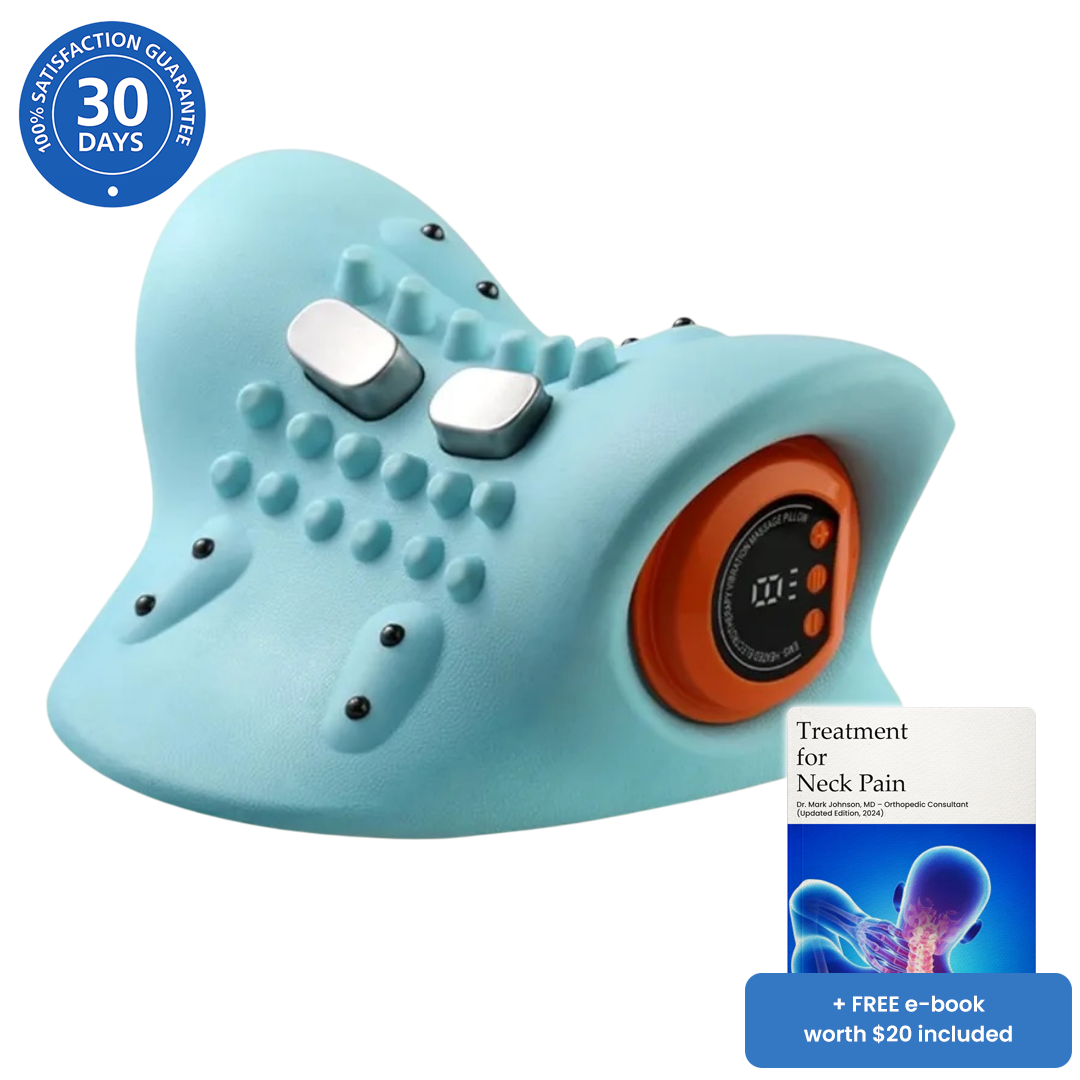
After 18 months of development, he created Neckline—a home device that delivers the same four clinical treatments simultaneously.
Medical-grade technology. Professional-level results. Home-use convenience.
All for $119.99.
But not for long.
The regular price is $239.98. But right now, Neckline is running their annual relief campaign—offering 50% off to help as many people as possible avoid expensive clinical treatments during the high-pain winter months.
Once the promotional period ends, the price returns to $239.98.
From $3,000/Month Clinical Treatments to Your Living Room
The Neckline device puts everything from Dr. Chen's four-part clinical protocol into one unit:
Medical-grade EMS that reaches deep muscles (replacing specialist electrical stimulation)
Therapeutic heat set to the exact temperature used in clinical settings
Precision massage points positioned where blockages form (mimicking manual therapy)
Gentle cervical traction that safely creates space between vertebrae (replacing physical therapy sessions)
You use it for 15 minutes a day.
Dr. Chen was skeptical at first. Could a home device really deliver the same results as his $200-per-session clinical protocol?
Dr. Richardson's team tested it on 50 patients who'd already tried everything — pills, Epley maneuvers, physical therapy, chiropractic — without relief.
The results shocked them.
After two weeks of daily 15-minute sessions:
94% had significantly less neck tension
87% experienced reduced dizziness and that "floating" feeling
83% noticed clearer thinking and less fog
79% felt less anxious
76% slept better
"These results matched—and sometimes exceeded—what we were seeing in the clinic."
Dr. Chen said. "Except patients were getting them at home, on their own schedule, without the $3,000/month price tag."
Real People, Real Relief
Jennifer Walsh, 38, suffered from mystery dizziness for three years.
"I had constant pressure behind my eyes, like my head was in a vise. The room would tilt when I bent down. My hands went numb while driving. Two MRIs, heart tests, ear tests — nothing showed up."
A friend told her about Neckline. She didn't believe it would work but was desperate.
"Within the first week the head pressure eased. By week two the floating feeling was gone. After a month I felt like myself for the first time in years."
Robert Brown, 52, dealt with daily heart palpitations and panic attacks on top of the dizziness.
"I thought I was having heart attacks. I went to the ER four times. They'd run tests and send me home saying my heart was fine."
His doctor finally checked his neck and found severe tension at the top of his spine.
"I started using Neckline twice a day. The dizziness faded within days. The panic stopped after about ten days. I couldn't believe something so simple fixed what six doctors couldn't."
These aren't rare cases. Over 47,000 people report similar results.
Why This Works When Everything Else Failed
The difference is simple: depth and completeness.
Pills mask symptoms. Basic massage only reaches surface muscle. The Epley repositions crystals you don't have. Stretching never touches the deep compression.
Neckline's four-part protocol works at every level:
The EMS breaks up the deep muscle tension that's been there for years
The heat reopens the blood vessels and restores oxygen flow
The massage calms your overworked nervous system
The traction releases the arteries the tension has been squeezing
Together they don't hide the dizziness — they restore normal blood and oxygen flow to your brain.
The same way Dr. Chen's $3,000/month protocol does.
What You're Probably Spending Now

Think about what you're already paying:
Anxiety/pain medication: $50-200/month, forever
Specialist visits: $150-400 per appointment
Physical therapy: $150-300 per session, 2-3x weekly
Chiropractic adjustments: $75-200 per visit
Lost days feeling like you're losing your mind: priceless
Most people spend thousands treating symptoms that never improve — because nobody is addressing the oxygen being choked off at the neck.
Neckline costs $119.99 (regular price $239.98). One-time payment. Use it forever.
That's less than one specialist visit.
The 30-Day Guarantee
Here's what makes this completely risk-free:
Use Neckline for 30 days.
If your dizziness, fog, and pressure don't dramatically improve — if you don't feel the steadiness and clarity that over 47,000 others have — send it back for a full refund. No questions asked.
Dr. Chen and Dr. Richardson offer this because they've seen the results.
Less than 1.3% of customers request refunds.
What Happens If You Don't Act

Here's the truth about neck compression:
it doesn't get better on its own. It gets worse.
Every day those deep muscles stay clenched, they squeeze the arteries a little harder, and your brain gets a little less oxygen. The dizziness comes more often. The fog thickens. The anxiety deepens.
What could be relieved in two weeks now might take months later — or become permanent.
Dr. Chen is blunt:
"Chronic restriction of the vertebral arteries starves the brain over time.
The longer you wait, the harder it is to reverse.
I've seen patients who waited years develop problems that became permanent because the compression went untreated for too long."
Your Two Choices

Choice 1: Keep taking pills that mask symptoms. Keep seeing specialists who treat everything except your Atlas. Keep hoping things improve on their own.
(They won't.)
Choice 2: Address the actual source with the same four-part clinical protocol that's helping thousands eliminate their mystery symptoms in just 15 minutes a day—without the $3,000/month cost.
Sarah Mitchell, who spent two years being misdiagnosed, says it best:
"I spent over $8,000 on specialists, tests, and medications that didn't work.
Neckline cost me $119.99 and gave me my life back. I only wish I'd found it sooner."
Choice 1: Keep taking pills that mask symptoms. Keep doing Epley maneuvers for crystals you don't have. Keep seeing specialists who check everything except your neck. Keep hoping it improves on its own.
(It won't.)
Choice 2: Address the actual source — the deep neck muscles strangling the oxygen to your brain — with the same four-part clinical protocol helping thousands feel steady again in just 15 minutes a day, without the $3,000/month cost.
Sarah Mitchell, who spent two years being misdiagnosed, says it best:
"I spent over $8,000 on specialists, tests, and medications that didn't work. Neckline cost me $119.99 and gave me my life back. I only wish I'd found it sooner."
Click the button below to check if it’s still in stock.
If it is, your discount will be applied automatically.
Recommended
★★★★★
Rated 4.8/5 | 12,000+ Customers
Neckline®

Relieves neck and back pain
Prevents dizziness and migraines
Relieves pain caused by herniated discs
Reduces stiffness and improves mobility